
Sensing Before Solving
This is the second in a four-part series exploring the ideas behind Pattern and Flow's complexity practice. Each post stands alone. Together, they build a foundation for working differently with organizational challenges that resist planning.
In the previous post in this series, I described a common experience: plans that fail not because of poor execution but because of a deeper confusion about what kind of situation we're in. We bring one mode of engagement — analysis, planning, expertise — to everything, even when the situation is inviting something fundamentally different.
This post introduces a practical framework for sensing that difference before you act.
Four Domains, Not Four Boxes
The Cynefin framework, developed by Dave Snowden and the Cynefin Company, offers four domains — not as boxes to sort things into, but as lenses for sensing what kind of engagement a situation is inviting.
The distinction matters. This isn't a classification exercise. It's a practice of paying attention to what's actually in front of you.
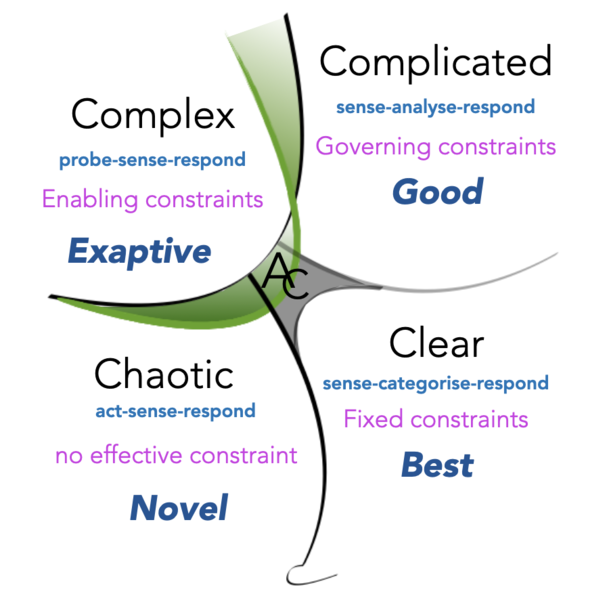
Cynefin Framework from File:Cynefin18FEB2021.png - Cynefin.io
Clear
Established practices work. The relationship between cause and effect is evident. Sense → Categorize → Respond.
When your car won't start, you don't need innovation — you need the mechanic to find the known issue. The situation has a right answer, and the path to it is well-established.
Complicated
Expert analysis reveals patterns. The relationship between cause and effect exists but requires investigation. Sense → Analyze → Respond.
When designing a new program, you can research what's worked elsewhere, analyze your context, and adapt accordingly. There may be multiple good answers, and expertise helps you find them.
Complex
Patterns emerge through engagement. The relationship between cause and effect can only be perceived in retrospect. Probe → Sense → Respond.
When building trust in a fractured team, no amount of planning reveals the path. You have to tend the conditions and see what becomes possible. The situation is made of living connections that shift as you engage them.
Chaotic
Immediate action creates ground to stand on. There is no relationship between cause and effect at the system level. Act → Sense → Respond.
When crisis hits, you stabilize first, understand later. The priority is establishing enough constraint to make the situation workable.
The Point Isn't Mastery
The point isn't to master these distinctions intellectually. It's to practice sensing which domain you're in before deciding how to engage.
And here's what makes this genuinely difficult: most real challenges don't live neatly in one domain. They live in multiple domains at once, or shift between them. A merger integration involves clear-domain work (payroll systems need to merge by a deadline), complicated-domain work (IT architecture requires expert analysis), and complex-domain work (cultural integration that no one can engineer). Using the same approach for all three is how organizations create the very dysfunction they're trying to prevent.
The Most Common Mistake
The most common failure mode — by far — is treating complex situations as if they were merely complicated. Assuming that if we analyze enough, plan enough, and get the right expertise, we'll find the answer.
But in complex domains, there is no answer to find. There are only patterns to participate in, conditions to tend, relationships to be present with.
When we misdiagnose complexity as complication, we create plans that can't account for how the system responds to our planning. We measure things that were never stable enough to measure. We optimize in ways that destroy the vitality we depend on.
This is not a failure of execution. It's a failure of sensing.
What Becomes Possible
When you recognize that you're in a complex situation, a different approach opens up.
Probe: Run small, safe experiments to see how the system responds. Sense: Pay attention to what's emerging — not just what you expected. Respond: Adjust based on what you're learning in relationship with the situation.
This is the practice of working with the grain rather than against it. Reading what's alive. Tending conditions rather than controlling outcomes.
It's not less rigorous than planning. It's rigorous about something different — about paying attention to what's actually happening rather than what your model predicts should happen.
A Practice, Not a Theory
Here's a question you can take with you, applicable the next time you face a challenge at work:
What domain is this situation living in? What kind of engagement is it inviting?
And a smaller one, for this week: What's one small way you could probe a current challenge — not to solve it, but to learn how it responds?
The next post in this series goes deeper: if we can sense that mechanistic methods don't fit a situation, why do we keep defaulting to them? Part of the answer is ontological — it lives in the language we use to think.
Continue Exploring
Previous:Why Your Plan Didn't Survive Contact with Reality — The felt experience of bringing the wrong mode of engagement to a living situation.
Next:The Language You Think In Shapes What You Can See — Why we keep defaulting to mechanistic engagement even when we sense it doesn't fit.
Also in this series:
An Ecological Vocabulary for Living Systems — Words adequate to the living systems we actually work in.
Pattern and Flow works with practitioners and organizations operating at the limits of what planning can accomplish. If this resonates with something you're experiencing, we'd welcome a conversation.
